IROS 2026
Towards Practical Scene Change Detection
A Fast, Unaligned Video Framework via Spatiotemporal Alignment
Abstract
Scene change detection that starts with the real world.
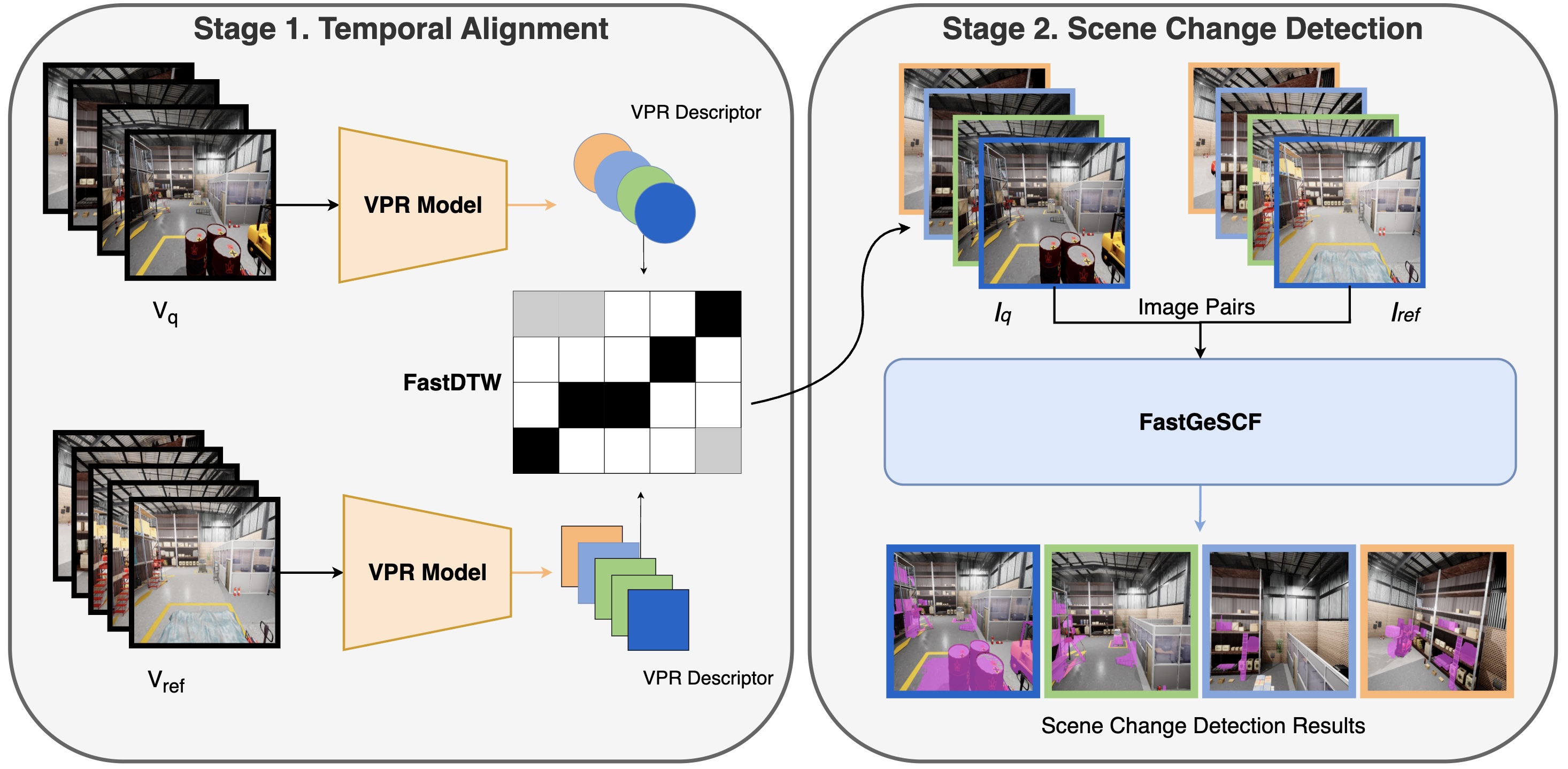
Scene change detection in robot deployments is difficult because repeated traversals are rarely captured at the same time, speed, or viewpoint. FastGeSCF detects meaningful scene changes directly from unaligned video traversals by combining temporal alignment, spatial registration, and selective segmentation.
The result is a practical two-stage pipeline that preserves competitive accuracy while substantially reducing per-pair inference time.
Full pipeline
From unaligned video traversals to change masks.
FastGeSCF
Spatial alignment, pseudo-mask generation, and selective SAM refinement.
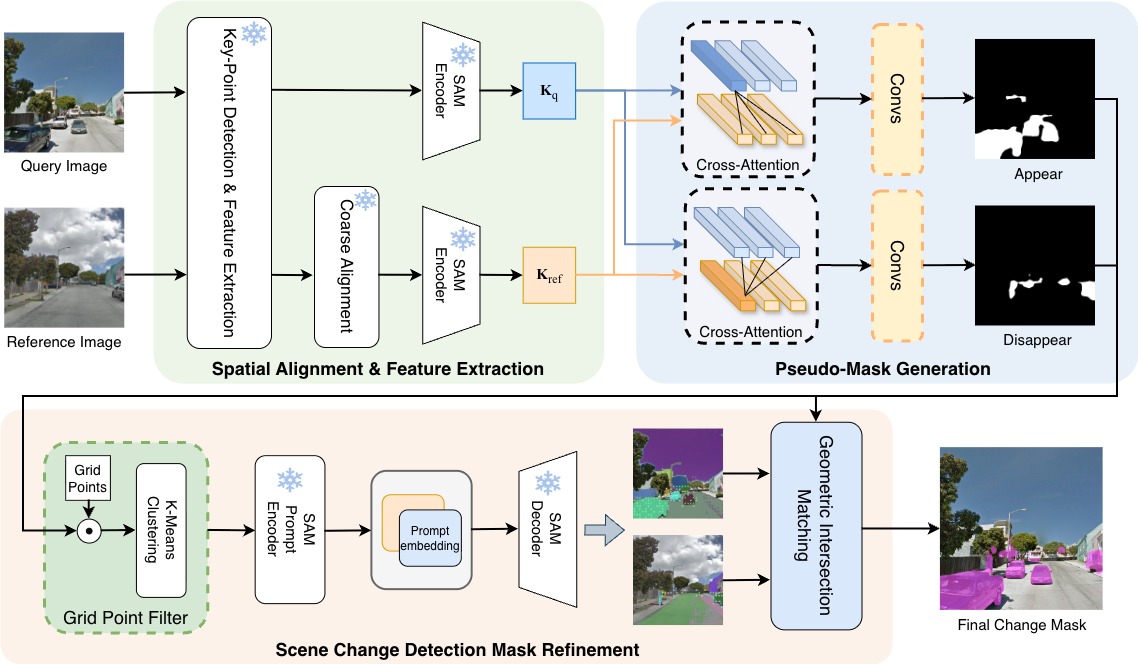
Robust correspondence. Temporal alignment handles uneven sampling and route speed.
Geometrically aware. Spatial registration reduces viewpoint-induced false positives.
Efficient masks. Selective prompting avoids expensive segmentation where it is unnecessary.
Results
Fast enough for practical video-based SCD.
| Method | Avg. F1 ↑ | Time / pair ↓ |
|---|---|---|
| GeSCF | 0.643 | 6.982 s |
| ZSSCD | 0.430 | 10.128 s |
| FastGeSCF | 0.658 | 0.888 s |
Citation
If FastGeSCF helps your research, please cite it.
@inproceedings{yeh2026fastgescf,
  title     = {Towards Practical Scene Change Detection: A Fast, Unaligned Video Framework via Spatiotemporal Alignment},
  author    = {Yi-Heng Yeh and Chuan-Yuan Huang and Kuan-Wen Chen and Li-Yu Lu},
  booktitle = {IEEE/RSJ International Conference on Intelligent Robots and Systems (IROS)},
  year      = {2026}
}